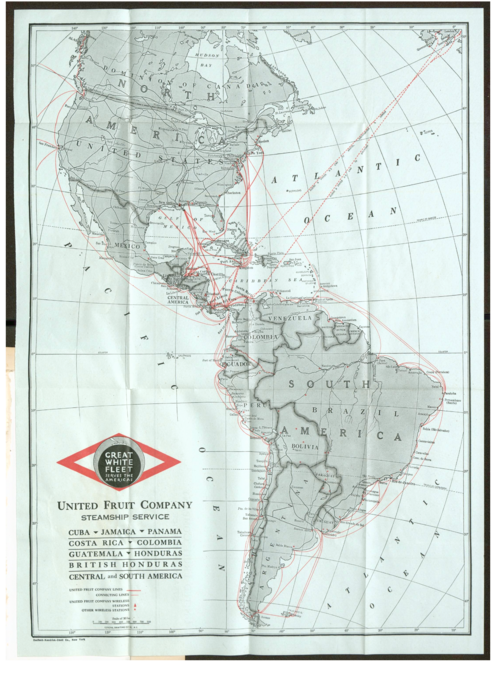
The United Fruit Company’s dominance over Central America is often remembered through the lens of economic power. Often through the vast amount of land they hoarded, their railroad monopolies, and even its influence over governments. But people often undermine how substantial and important their dominance over information and their use of control strategies was to their success. The research question that this project aims to answer is: How did the United Fruit Company control information and how did they use that control as a tool of political domination? The purpose of my project is to demonstrate that the information control strategies used by the United Fruit Company were pivotal to its rule over Central America.
This research question is extremely historically significant for a multitude of reasons. It forces us to reframe our views on corporate power in the twentieth century. It also helps us to understand that the destruction of the Guatemalan government that led to years of civil war and a dictatorship wasn’t a byproduct of Cold War politics. We now can understand that the destruction of the Guatemalan government was deliberate and planned by the United Fruit Company due to the earlier government’s attempts at returning land to their people. ¹ When information is withheld from the public and propaganda is spread, the public becomes uninformed and uneducated which is dangerous for society. The public doesn’t know how to support and who to trust, so they might support the wrong person. Studying this research question can help us to prevent the use of information control in the future and protect ourselves if they are used against us. ²
Through the examination of declassified documents, corporate records, speeches, and firsthand accounts, this project argues that the United Fruit Company’s control over information and use of propaganda was one of the most essential weapons they used to be as dominant and successful as they were. The primary sources selected demonstrate three interconnected themes of information control. The Central Intelligence Agency ‘s 1952 intelligence report on Árbenz, the Fishburn State Department memorandum of 1950, and the NSC Planning Board report on the antitrust suit against the UFC reveal that the U.S had internal evidence that contradicted the communist narrative the UFC was trying to push onto Árbenz, yet chose to act according to the UFC demonstrating that the company’s information control strategies were so powerful that they overrode the government’s own findings. The United Fruit Company’s own documents, the 1909 map of Central America and its 1917 Medical Department annual report, reveal how the company tried to forge a public image of itself as a modern, strong force. The CIA’s classified report on the position of the United Fruit Company in Central America, the CIA’s own internal history of Operation PBSUCCESS which was a CIA covert operation that overthrew Guatemala’s democratically elected President Jacobo Árbenz, and Árbenz’s resignation speech demonstrate how the U.S viewed the United Fruit Company’s control over communications and transportation and how the propaganda campaign succeeded in bringing down Árbenz. These eight primary sources reveal the structure of a deliberate information strategy to aid the United Fruit Company in its dominance over Central America.
The United Fruit Company was founded in 1899 and by the early 1930s had absorbed more than twenty rival firms. It controlled not only banana plantations but also railroads, ports, telegraph lines, and even Guatemala’s postal service. This gave it huge control over the governments of those regions. ³ The UFC owned a staggering 42% of Guatemalan lands. Out of that 42%, only 15% was being utilized leaving a huge amount of land owned but untouched. ⁴ This led the Guatemalan President Jacobo Árbenz to pass land reform laws in 1952 that distributed the land held by huge companies such as the United Fruit Company back to peasants. The United Fruit Company hired Edward Bernays and lobbyist Thomas Corcoran to reframe the land reform as a communist threat. This was done to give the U.S a reason to overthrow Árbenz so the company could keep their land. ¹ By 1954, the Eisenhower administration authorized the CIA to launch Operation PBSUCCESS. This was the covert operation that combined psychological warfare, fake radio broadcasts, and an invasion force from the U.S that forced Árbenz to resign on June 27, 1954. ²
The story of the United Fruit Company and their reign of terror is often one explained by the political and economic, but I believe their information control strategies played a bigger role than most realize and was the key to their success and domination in Central America. By utilizing strategies such as planted newspaper stories, fake radio broadcasts, and coordinated congressional lobbying, the United Fruit Company demonstrated that tricking and influencing a government to aid them to overthrow another government was a possibility. The eight primary sources utilized in this project provide direct evidence of how this information system was built and used. The objective of this project is to reframe how we understand the strategies the United Fruit Company used to come and stay in power and to prevent an entity from using these strategies against civilizations in the future.
Sources
¹ Aaron Coy Moulton, “Before Venezuela’s Oil, There Were Guatemala’s Bananas,” The Conversation, January 15, 2026, https://theconversation.com/before-venezuelas-oil-there-were-guatemalas-bananas-272973.
² Jake Beecroft, “Journey to Banana Land: How the United Fruit Company Colluded with the CIA to Topple Guatemala’s Elected Government,” Retrospect Journal, February 2, 2025, https://retrospectjournal.com/2025/02/02/journey-to-banana-land-how-the-united-fruit-company-colluded-with-the-cia-to-topple-guatemalas-elected-government/.
³ Michael Fox. “The Shadow of the United Fruit Company Still Reaches Across the Globe Today.” The World from PRX, March 26, 2024. https://theworld.org/stories/2024/03/26/shadow-united-fruit-company-still-reaches-across-globe-today.
⁴ “The United Fruit Company in Guatemala (Background + Coup),” History in Charts, November 15, 2023, https://historyincharts.com/the-influence-of-the-united-fruit-company-in-guatemala/.