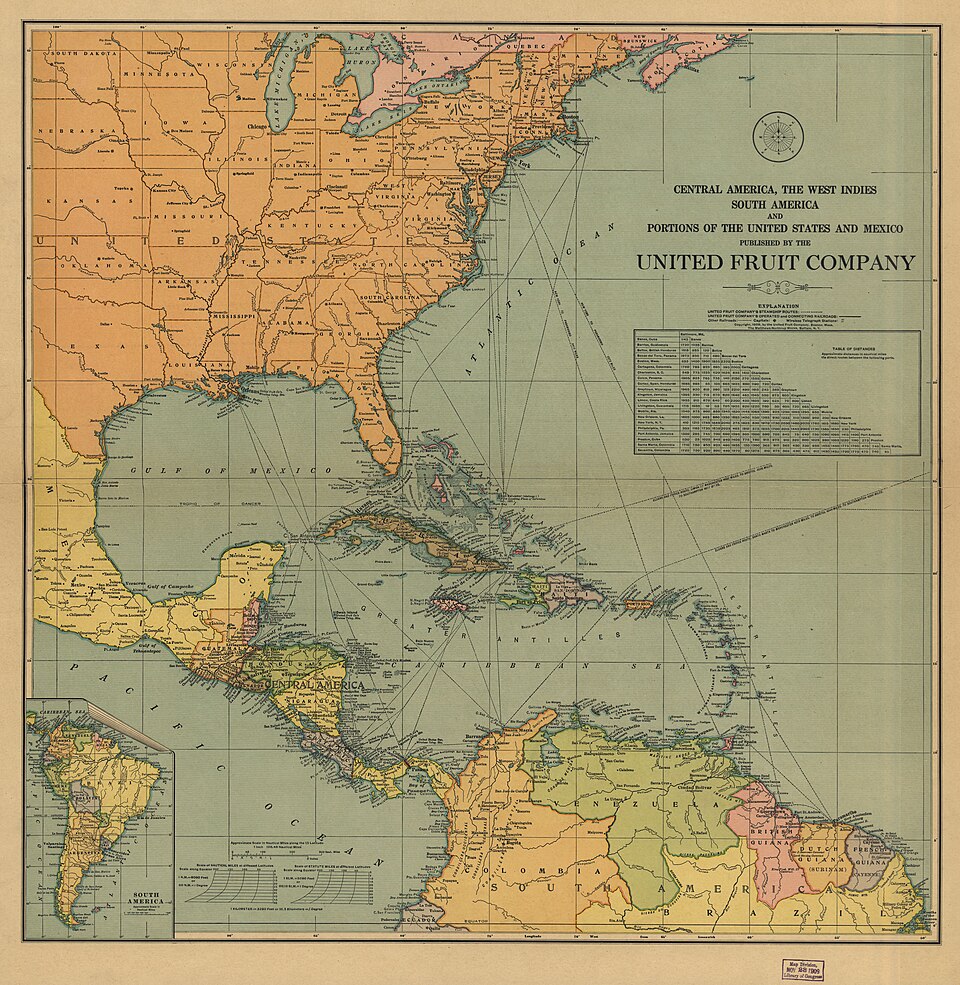
The United Fruit Company’s dominance over Central America has been heavily documented by scholars, but historians and political scientists have approached the question of how that dominance was maintained from very different angles. The focus of how that dominance was maintained is usually through an overwhelming stronghold on the economy, but another angle focuses on how the UFC used information control strategies to dominate Central America. This historiography examines the work of three scholars — Roberto Garcia Ferreira, Aaron Coy Moulton, and Marlies Glasius — whose work together reveals that the United Fruit Company utilized complex and strategic information control campaigns to dominate over Central America.
These three sources together reveal that the UFC’s information control operated at every level of society at once. Garcia Ferreira shows that the information campaigns used by the UFC did not end after the coup but were continued for years afterward as the CIA worked to bury Jacobo Árbenz’s political credibility in the ground. Moulton demonstrates that the UFC created the anticommunist narrative that justified U.S. intervention in Guatemala using lobbyists to sculpt American political opinion before the 1954 coup. Glasius reveals that strategies such as silencing, secrecy, and deception were also utilized against their own plantation workers. The comparison of these three sources demonstrates that information control strategies were not a tactic only used against Arbenz but were rather instrumental in the total success of the United Fruit Company. 
The article “THE CIA AND JACOBO ARBENZ: HISTORY OF A DISINFORMATION CAMPAIGN” by Roberto Garcia Ferreira examines the CIA’s campaign to destroy Jacobo Árbenz’s public image after he was overthrown in 1954. It focuses on how the agency planted stories in newspapers across all Latin America, confiscated and tampered with his personal papers, and coordinated with journalists to politically discredit him for many years following his exile. Garcia Ferreira argues that the CIA’s information campaign against Árbenz did not end with the 1954 coup. He argues that it continued for many years after that to prevent Árbenz from reviving his political career. Roberto Garcia Ferreira is a Professor in the Department of History of the Americas at the University of the Republic in Montevideo, Uruguay. He is extremely credible and an expert in the field which makes his work relevant to the project. He uses declassified CIA documents as well as Guatemalan and Uruguayan press archives as his main pieces of evidence to prove his claims. Garcia Ferreira acknowledges limitations in evidence such as the scarcity of CIA records on Arbenz after 1960. Garcia Ferreira compares CIA operational plans against the press coverage they generated to prove a connection between CIA directives and what appeared in Latin American newspapers. There are observable biases in the article such as his sympathetic portrayal of Árbenz as a victim. Garcia Ferreira’s greatest strength is his establishment of a connection between CIA operational plans and the media coverage they produced, which provides him proof that the campaigns were deliberate. Garcia Ferreira’s greatest weakness was that his analysis becomes less reliable after 1960 because the CIA records he used to compare to the press coverage were scarce. While Moulton focuses on how the United Fruit Company utilized lobbyists to shape the American opinion prior to the Guatemalan Coup, Garcia Ferreria shows that the campaigns lasted far beyond the coup. Garcia Ferreira’s argument is convincing because he compares CIA operational plans with the press coverage they generated. His interpretations become less valid after the 1960s due to the scarcity of the CIA records.
The article “Anti-Communist Bananas: The United Fruit Company versus the Guatemalan Revolution” by Aaron Coy Moulton shows how the United Fruit Company hired lobbyists to convince American politicians and the press that Guatemala’s land reform was a communist threat. Moulton argues that the United Fruit Company created anticommunism to frame Guatemala’s land reform as bad for the United States. Moulton is an associate professor of Latin American History at Stephen F. Austin State University who has done extensive research into the United Fruit Company making his work relevant to this project. Moulton proves his claims using lobbyist Thomas Corcoran’s personal papers at the Library of Congress. Moulton acknowledges that the UFC hasn’t provided its internal archives meaning the full internal record of UFC’s decision making remains inaccessible. Moulton uses a methodology that is centered on the personal papers that he uses to show how UFC’s anticommunist narrative moved from private lobbying conversations into congressional speeches and press coverage. One assumption he makes is that the UFC was the primary driver of U.S intervention without considering that some American politicians may have wanted to intervene for reasons related to the Cold War such as Eisenhower administration’s goals to keep a leftist government out of power in Latin America. Moulton’s greatest strength in this work is his use of Corcoran’s personal papers that provided him proof that UFC’s propaganda talking points were directly adopted by U.S. politicians. Moulton’s greatest weakness is that the UFC has never provided its own internal archives, leaving how they made their decisions misunderstood. While Moulton examines how UFC used information control to create the political conditions that made the 1954 coup possible, Garcia Ferreira shows that the same strategies continued long after the coup as the CIA worked to permanently destroy Árbenz’s political credibility. Moulton’s argument is extremely convincing Corcoran’s personal papers provide proof that UFC’s anticommunist messaging was adopted by U.S. politicians, though his argument becomes less convincing when he establishes that the UFC was the main reason for U.S intervention without accounting for the other reasons that U.S politicians might’ve wanted Árbenz overthrown.
The article “One hundred years of authoritarian practices: United Fruit and its banana plantation workers” by Marlies Glasius examines how the United Fruit Company controlled its plantation workers across more than a century. They did this by blocking their access to information to keep the workers from organizing. Glasius’s main argument is that the UFC deliberately kept workers uninformed and unable to organize to maximize their profits. She argues they did this so that they couldn’t recognize their rights and fight back. Marlies Glasius is a professor of International Relations in the Department of Politics at the University of Amsterdam. Her research mainly specializes in authoritarianism, global civil society, and international criminal justice, making her work relevant to my research project. Glasius uses secondary sources from anthropologists, sociologists, and labor historians who conducted fieldwork on UFC plantations to prove her claims. Glasius acknowledges that the reliability of her claims depends on the quality of the sources she uses. She uses a political science framework about how corporations deliberately block information to avoid being held accountable and applies it to UFC specifically. She reveals that the company’s suppression of workers’ voices and access to information was a form of corporate authoritarianism. Glasius’s main bias is that she tends to interpret UFC’s actions as intentionally authoritarian even when the company may have done something as a response to business pressures. Glasius’s biggest strength in this work is her broad scope, where she reveals the company’s information control as a fundamental strategy rather than a single incident. Glasius’s biggest weakness in this work is how she relies on secondary sources, meaning her work is only as reliable as those sources are. While Moulton focuses on how the company used information control to shape American political opinion and government policy, Glasius focuses on how the company used information control to maintain dominance over the plantation workers. Glasius’s argument is convincing because she demonstrates the same pattern of silencing and secrecy over a long period of time. The most valid interpretation in Glasius’s work is that the UFC used information control to keep workers uninformed and unable to organize because she shows how the same strategies were utilized across different countries and times.
Together, Garcia Ferreira, Moulton, and Glasius demonstrate that the United Fruit Company information control strategies were not used one time in response to a specific crisis but were long-term and evolving that operated at multiple levels of society. Garcia Ferreira shows how the CIA continued their information campaigns long after the coup to permanently silence Árbenz. Moulton shows how UFC manufactured the political conditions that made the 1954 coup possible. Glasius shows that the silencing and deception were used against UFC’s own workers across more than a century of operations. These three scholars demonstrate how the information control strategies were fundamental to its dominance in Central America. Although scholars have made remarkable progress in understanding the campaigns and authoritarian labor practices used by the United Fruit Company, the most important question about how exactly these strategies were planned and executed remain only partially answered because the company’s archives are unavailable to scholars.
Sources
- Garcia Ferreira, Roberto. “The CIA and Jacobo Arbenz: History of a Disinformation Campaign.” Journal of Third World Studies 25, no. 2 (Fall 2008): 59–81. https://www.jstor.org/stable/45194479.
- Moulton, Aaron Coy. “Anti-Communist Bananas: The United Fruit Company versus the Guatemalan Revolution.” Diplomatic History 47, no. 3 (June 2023): 472–500. https://doi.org/10.1093/dh/dhad009.
- Glasius, Marlies. “One Hundred Years of Authoritarian Practices: United Fruit and Its Banana Plantation Workers.” Journal of International Relations and Development 26 (2023): 245–271. https://doi.org/10.1057/s41268-023-00294-2.